Appointment Only.

Your Account
Page Content Top
Page Content
Blog CF - Fine Jewellery & Antiques
The Beauty Behind the Star – What Makes a Star Sapphire a Star? - 2026-09-17
The Beauty Behind the Star – What Makes a Star Sapphire a Star?
The Links Open New Windows
Not every gemstone is meant to sparkle with facets.
Some of the most captivating stones in the world reveal their beauty through a much older and seemingly simpler style of cutting: the cabochon.
Smooth, polished and softly domed, a cabochon — often affectionately called a “cab” — has no facets. Instead of being cut to create flashes of reflected light, the stone is shaped and polished to showcase its colour, character and, in certain exceptional gems, a remarkable optical phenomenon hidden within.
What Is a Cabochon?
A cabochon is a gemstone that has been shaped and polished rather than faceted. It will typically have a smooth, rounded dome with a flat or slightly curved base.
The style is particularly suited to translucent and opaque gemstones, or stones whose inclusions create unusual optical effects.
While a faceted cut is designed to manipulate light through a series of precisely angled surfaces, the beauty of a cabochon comes from its uninterrupted surface. Colour appears softer and deeper, inclusions become part of the stone’s character, and certain natural phenomena can suddenly become visible.
Among the most extraordinary of these is asterism — the appearance of a star.
What Makes a Star Sapphire a Star?
A star sapphire does not have a star sitting on its surface. The phenomenon comes from within the gemstone itself.
Sapphires are composed of corundum, and some contain extremely fine, naturally oriented needle-like inclusions, commonly rutile — sometimes referred to as “silk.”
When light strikes these microscopic inclusions, it is reflected and scattered into narrow bands of light. Where those bands intersect, they create what appears to be a luminous star floating across the surface of the gemstone.
This phenomenon is known as asterism.
It is also why the cabochon cut is so important. The curved dome concentrates the reflected light into visible bands. A skilled cutter must study the rough gemstone carefully and orient the cabochon correctly so that the star appears as close as possible to the centre of the dome.
When the stone is moved beneath a single light source, the star appears to glide gracefully across its surface.
It is one of those wonderful occasions in gemology where an inclusion — something that might be considered an imperfection in another gemstone — becomes the very thing that makes the stone extraordinary.
Why Do Some Stars Have More “Legs” Than Others?
The “legs” of a star are more properly called rays, and the number of rays is determined by the internal structure of the gemstone and the directions in which its microscopic inclusions are oriented.
Star sapphires and star rubies most commonly display six rays. Three directions of aligned inclusions create three intersecting bands of reflected light, producing the familiar six-rayed star.
Other gemstones can produce different patterns. Some star gems display four rays, while particularly unusual sapphires can exhibit twelve-rayed stars.
A twelve-rayed sapphire can occur when two different sets of inclusions are present and oriented differently within the same stone. The result is essentially two six-rayed stars overlapping one another.
The quality of a star is not determined simply by the number of rays, however. A particularly beautiful star will be sharp and well defined, properly centred, and have rays that extend evenly across the cabochon. Most importantly, the star should move smoothly across the gemstone as the stone or light source moves.
The Importance of Light
Star sapphires are wonderfully responsive to their surroundings.
Their asterism is generally most dramatic beneath a strong, relatively concentrated light source. Natural daylight can be particularly beautiful, revealing subtleties of colour and character that artificial lighting may not reproduce in quite the same way.
This is why a star sapphire can look remarkably different as it moves from one lighting environment to another.
Turn the stone gently in the light and its star seems almost alive.
Natural Stars — And the Famous Linde Stars
Not every star sapphire is natural.
One particularly interesting chapter in twentieth-century gemology began with the Linde Air Products Company, which developed synthetic star ruby and star sapphire.
Linde's man-made star stones were publicly announced in September 1947, although the company stated that the method had been discovered during the early years of the Second World War and that wartime demands had delayed commercial production.
These stones became known as Linde Stars and are an interesting part of mid-century jewellery history.
They were genuine synthetic corundum — possessing essentially the same fundamental mineral composition as ruby and sapphire — but grown by man rather than formed naturally within the earth. Their asterism was deliberately produced through carefully controlled internal needle-like structures.
Today, an original Linde star sapphire can be an appealing period object in its own right, particularly when it survives in an original mid-century setting. It should, however, always be distinguished from a naturally formed star sapphire.
Beauty in Imperfection
Perhaps the most fascinating thing about a star gemstone is that its beauty depends upon what lies inside it.
The microscopic inclusions responsible for the star might ordinarily be described as imperfections. Yet without them, there would be no star at all.
A fine star sapphire is therefore not about absolute clarity.
It is about the relationship between colour, translucency, inclusions, cutting and light — all coming together to produce something that appears almost impossible: a star that seems to float across a gemstone.
And unlike the brilliance of a faceted stone, which is immediately apparent, the beauty of a star sapphire asks you to move it, turn it and watch.
Sometimes the most interesting gemstones are the ones that reveal themselves slowly.
Contact us to try on star sapphire rings.
First Jewellery on Mars: What Will Humanity’s First Piece of Jewellery on the Red Planet Be? - 2026-07-27
First Jewellery on Mars: What Will Humanity's First Piece of Jewellery on the Red Planet Be?
The Links Open New Windows
As humanity prepares for its next great adventure—sending astronauts to Mars—most conversations focus on rockets, habitats, robotics, and the search for life.
But there is another fascinating question that deserves attention:
What will be the first jewellery on Mars?
Throughout history, jewellery has travelled wherever people have gone. From ancient civilizations to polar expeditions, from ocean crossings to the International Space Station, precious objects have always accompanied explorers. When humans finally step onto Mars, it seems almost certain that a piece of jewellery will be there too.
Why Jewellery Matters in Space Exploration
Jewellery has never been merely decorative. It tells stories, celebrates milestones, preserves memories, and connects generations.
Astronauts have long carried deeply personal items into space, including wedding rings, family photographs, medals, and mission keepsakes. These objects remind them of home during extraordinary journeys.
The first jewellery on Mars will likely serve the same purpose.
Whether it is a wedding band, a signet ring, or a cherished family heirloom, it will symbolize the enduring human need to carry love, memory, and identity wherever we travel.
What Could Be the First Piece of Jewellery on Mars?
Several possibilities stand out.
A Wedding Ring
The most likely candidate is a simple wedding ring. Many astronauts are married, and wedding bands are among the most meaningful personal items anyone owns. A plain gold or platinum ring could quietly become the first jewellery ever worn on Mars.
A Family Heirloom
Imagine an antique ring passed through generations making the 225-million-kilometre journey to the Red Planet. A Victorian ring or an Edwardian diamond brooch would unite centuries of history with humanity's future among the stars.
A Mission Commemorative Piece
Space agencies may eventually commission special medals, pins, or commemorative jewellery to celebrate the first Martian missions. These pieces could become some of the most collectible space-related artefacts ever created.
An Antique Timepiece
Although technically not jewellery, luxury watches have accompanied astronauts throughout the history of space exploration. A historic mechanical watch could easily become one of the first valuable personal objects to arrive on Mars.
Could Vintage Jewellery Survive Mars?
Surprisingly, many precious materials are exceptionally durable.
Gold does not tarnish or rust.
Platinum is highly resistant to corrosion.
Diamonds are among the hardest natural materials on Earth.
While Martian dust, extreme temperatures, and radiation present engineering challenges, properly protected precious jewellery could remain beautiful for generations.
Some vintage jewellery has already survived almost a hundred years on Earth. There's every reason to believe carefully preserved pieces could accompany humanity into the next era of exploration.
Why the First Jewellery on Mars Will Become Historic
Every great exploration creates iconic objects.
The first flag on the Moon.
The first camera used in orbit.
The first vehicle driven across another world.
The first jewellery on Mars will join that remarkable list.
Collectors, museums, historians, and future generations will look back on that moment as another milestone in human history. The object itself may be modest, but its significance will be immense.
The Connection Between Ancient Craftsmanship and Future Exploration
One of the most fascinating possibilities is that the first jewellery on Mars may not be newly made at all.
Imagine ancient Roman coins set in earrings.
An Art Deco diamond.
These pieces have already witnessed centuries of history on Earth. Carrying one to Mars would add an entirely new chapter to its story—a journey no artisan who created it could ever have imagined.
Antique jewellery has always connected people across generations. One day, it may connect planets as well.
Will Jewellery Be Made on Mars?
As permanent settlements become reality, jewellers may eventually create pieces using Martian materials or advanced manufacturing technologies.
Future Martian jewellery could combine precious metals brought from Earth with locally produced components, creating entirely new forms of craftsmanship inspired by another world.
Collectors of the future may one day treasure "Made on Mars" jewellery in much the same way we value historical pieces today.
Looking Ahead
The first jewellery on Mars may never make headlines like the first footprint or the first habitat. Yet it will represent something uniquely human.
Long after the first missions have passed into history and the technology has evolved, one small piece of jewellery may remind us that exploration has never been just about survival.
It has always been about carrying our stories, our memories, and our humanity into the unknown.
Perhaps the first jewellery on Mars is already sitting quietly in a jewellery box today, waiting for its greatest adventure.
At Cynthia Findlay Fine Jewellery & Antiques, we firmly believe that this Edwardian 0.30ct. sapphire and diamond hinged bracelet in 9kt. yellow gold will be the first piece of antique jewellery to reach Mars!
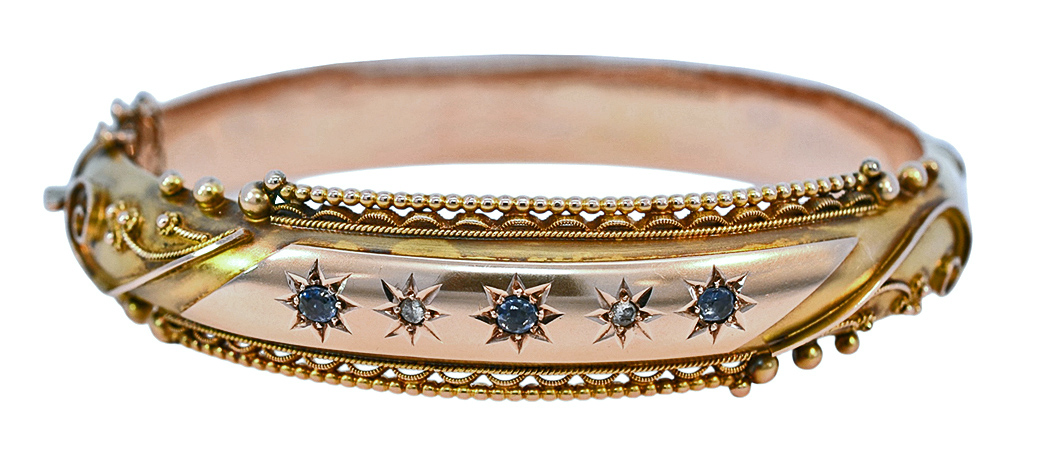
Contact us to find the perfect treasure to take with you to the Red Planet—and beyond.
Summer Style with a Story - 2026-06-25
Summer Style with a Story: Discover Timeless Treasures This Season
The links open on new windows
Summer has a way of inviting us to slow down. Whether it's an afternoon spent exploring the city, an evening gathering with friends, or a weekend away at the cottage, the season reminds us to enjoy life's simple pleasures—and to surround ourselves with things that bring lasting beauty.
At Cynthia Findlay Fine Jewellery & Antiques, we believe the most memorable pieces aren't simply purchased—they're discovered. Every antique, estate jewel, and work of art has a history, a character, and a story waiting to become part of your own.
Jewellery That Goes Beyond Trends
While fashion changes with every season, exceptional jewellery never loses its appeal.
Estate diamonds, antique gold, vintage watches, and coloured gemstones offer something increasingly rare: individuality. These are pieces crafted to endure, often by hand, with a level of artistry that is difficult to replicate today.
Whether you're attending a summer wedding, celebrating a milestone, or simply looking for something beautiful to wear every day, choosing an antique or estate piece means owning something truly unique.
The Beauty of Living with Antiques
Summer entertaining doesn't have to be elaborate. A simple meal becomes special when served on fine porcelain, with sterling silver on the table or crystal catching the evening light.
Antiques have a remarkable ability to make everyday moments feel meaningful. They bring warmth, craftsmanship, and personality into a home while connecting us to generations of skilled artisans.
Many of our clients enjoy mixing antique treasures with contemporary décor, creating spaces that feel both elegant and lived in.
Collecting with Confidence
One of the pleasures of collecting is discovering the unexpected.
You don't need to be an expert to begin. Start with pieces that speak to you—perhaps a Victorian brooch, a Georgian silver box, a piece of Moorcroft pottery, or a beautifully preserved piece of Canadian art. Over time, your collection becomes a reflection of your own taste and the stories you've chosen to preserve.
Our knowledgeable team is always happy to share the history behind each piece and help collectors at every stage of their journey.
Sustainable Luxury
Choosing antique and estate jewellery is also one of the most sustainable ways to shop. These remarkable pieces have already stood the test of time and can continue to be worn and enjoyed for generations to come.
Investing in antiques is an investment in craftsmanship, history, and enduring quality—a thoughtful alternative to today's fast-moving trends.
Visit Us This Summer
Throughout the summer, our showcases continue to evolve with newly acquired jewellery, silver, porcelain, and decorative arts. Whether you're searching for a special gift, adding to a collection, or simply looking for inspiration, there is always something new to discover.
We invite you to visit Cynthia Findlay Fine Jewellery & Antiques and experience the timeless beauty of pieces that have been treasured for generations—and are ready to begin their next chapter with you.
After all, true elegance is never seasonal.
RVP


Cynthia Findlay Fine Jewellery & Antiques
284 King Street West, Toronto, Ontario, M5V 1J2
Contact | 416.260.9057 | 1.855.260.9057